Crambe Oil Beyond Skincare: Industrial Uses
Mention crambe oil to a materials scientist and you will not hear about skin or hair. You will hear about steel casting, plastic film and nylon. For decades the plant was grown for factories, and it is a fun twist that the same seed now fills our bottles of Abyssinian oil.
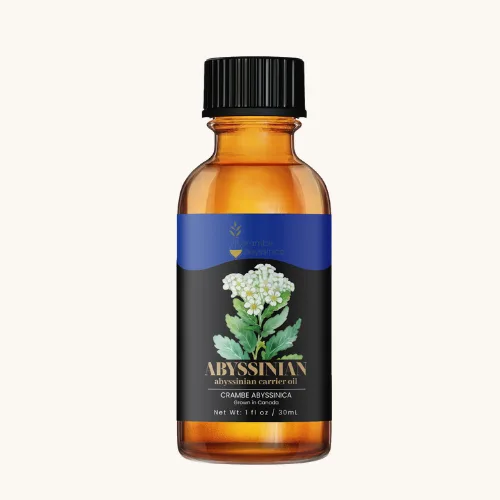
Abyssinian Oil
Cold-pressed Abyssinian oil, in sizes from 0.5 oz to bulk.
From $11.99
Shop Abyssinian Oil →The reason: one fatty acid
Everything starts with erucic acid. Purdue University's NewCROP page puts it at 55 to 60 percent of crambe oil, and a 2020 review in Agronomy says up to 60 percent. That is far above what is in the oils people cook with, where canola is legally limited to 2 percent. For an industrial chemist, a seed oil made mostly of one long, straight fatty acid is a gift, because it is a uniform starting point.
A 1971 review in the Journal of the American Oil Chemists' Society laid out the list. Compared with rapeseed oil, crambe oil is better suited to industry because it consistently carries more erucic acid. It listed lubricants for continuous steel casting, formulated lubricants, rubber additives and waxes made by hydrogenating the oil.
Slip agents, lubricants and a long-named nylon
The most visible use is erucamide, an additive that makes polyethylene film slide against itself. We unpack the mechanism in how crambe oil ends up in plastic films.
Lubricants are the next branch. Erucic-rich oils have a high degree of lubricity and a tendency to cling to surfaces, as a 2019 paper in Plant Biotechnology Journal puts it, and erucic derivatives including erucamide, behenyl alcohol and brassylic acid feed into lubricants, slip additives, plasticizers and surfactants.
The most unusual branch is nylon 1313. Cleaving erucic acid in the middle gives brassylic acid, a 13-carbon acid, which can be built into nylon 1313. A 1990 Biotechnology Progress paper describes nylon 1313 as durable, chemical and water resistant, dimensionally stable and a good electrical insulator, and it named crambe or industrial rapeseed as the source of the erucic acid. The paper was largely an economic feasibility study, and its main finding was that the cost of making the nylon hinged on the price of the feedstock and the value of the by-products.
A crop with a short factory career
Crambe came to the US in the 1940s through a Connecticut experiment station, and Texas began evaluating strains in 1958, according to extension material from the University of Wisconsin and Minnesota. The 1971 review noted that the USDA had recommended it as a practical domestic source of high-erucic oil, since the US was importing rapeseed oil for the purpose. Even the seed meal found work: it is FDA-approved as a supplement for beef cattle at up to 5 percent of daily intake, though not for animals with a single stomach.
Why did it stay modest? The 2020 review points to seed yield that needs to rise before crambe can compete with high-erucic rapeseed, and the agronomy knowledge gaps that go with a small crop. That seems to us an honest summary: a capable plant with a niche to fill, not a replacement for the big oilseeds.
Same oil family, very different jobs
For a deeper look at the plant, there is our crambe plant guide. To see how crambe sits next to its cousins, read crambe vs rapeseed vs canola. For what the same fatty acid means in a cosmetic oil, the fatty acid profile post covers it.
None of this changes what our bottle is. It holds a cold-pressed, light golden oil for skin and hair, a gentle everyday use for a plant that spent decades being studied for the factory floor and the steel mill.
Abyssinian Oil
Cold-pressed Abyssinian oil, from a small bottle to bulk sizes.
From $11.99
Shop Abyssinian Oil →Sources & Further Reading
- Crambe abyssinica Hochst. ex R.E.Fries (Purdue University NewCROP)
- Crambe (Crambe abyssinica Hochst): A Non-Food Oilseed Crop with Great Potential: A Review (Agronomy, 2020)
- Industrial uses of high erucic oils (Journal of the American Oil Chemists' Society, 1971)
- The impact of reducing fatty acid desaturation on the composition and thermal stability of rapeseed oil (Plant Biotechnology Journal, 2019)
- Process Design, Economic Feasibility, and Market Potential for Nylon 1313 Produced from Erucic Acid (Biotechnology Progress, 1990)
- Crambe (University of Wisconsin-Madison and University of Minnesota Extension, 1991)