Why Abyssinian Oil Feels Silky: Its Fatty Acids Explained
Every plant oil is a recipe of fatty acids, and Abyssinian oil's recipe has one dominant ingredient that most oils barely contain. Understand that single fatty acid and you understand most of why the oil feels light, why it keeps well in principle, and why it was once grown for factories before it was ever bottled for skin.
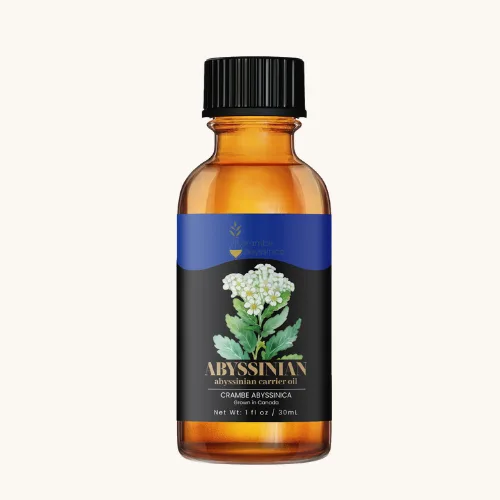
Abyssinian Oil
Cold-pressed Abyssinian oil, in sizes from 0.5 oz to bulk.
From $11.99
Shop Abyssinian Oil →The headline acid: erucic
Published descriptions of crambe oil put erucic acid at around 50 to 60 percent of the oil. That is the one number worth remembering. A review of the crop describes the oil as rich in erucic acid, with smaller amounts of the more familiar oleic, linoleic and linolenic acids alongside it.
Erucic acid is a long-chain monounsaturated fat: a long carbon chain with a single double bond, and it belongs to the omega-9 family. Most of the oils people know on a bathroom shelf lean on shorter chains, so a profile dominated by this long one is distinctive. Our product page describes our Abyssinian oil as high in unsaturated omega-9 and omega-6 fatty acids, and that is as far as we go about the exact make-up of ours.
What a long single-bond chain does
This part is reasoning, not a measurement, so treat it as the way we connect the chemistry to the feel. Fatty acids with several double bonds tend to make thin, quickly changing oils; fatty acids with one tend to make oils that are smoother and steadier. A heavy proportion of long, single-bond chains points toward a silky, lightweight finish, and toward better resistance to going off than a polyunsaturated oil of the same age. A recent study on the oxidation of cosmetic and food oils makes the general point: jojoba is noted for high oxidative resistance because of its monounsaturated structure, while rosehip's high unsaturation reduces its stability.
We think that fits our product page, which calls the oil lightweight and non-greasy. If you want the storage side of this story, Abyssinian oil shelf life and storage picks it up, and oxidative stability goes deeper for formulators.
Numbers move with the crop
Here is something that is worth knowing before you compare any two bottles: crambe oil is an agricultural product, and agricultural products vary. The 50 to 60 percent figure is a range across published work on the crop, not a promise about any one lot, so please read it as a general picture of crambe oil and not as a figure for a particular bottle. For formulation work, the useful habit is simple: ask any supplier what documents they can provide for the lot in front of you, and tell us which documents you need before you order if you are buying from us. Our post on specifications covers what to ask.
The erucic acid question
You will see erucic acid discussed alarmingly in connection with food, because food rules do limit it in oils like rapeseed and canola. That is a food regulation matter, and a cosmetic oil is a different category: ours is for external use on skin and hair. Crambe appeals to industry precisely because it is rich in erucic acid, which is used in things such as plastic films and lubricants, and a review of the crop notes it as a source that avoids crossing with food rapeseed. If you want the eating question answered plainly, read is crambe oil edible, and for the industrial side, crambe oil industrial uses.
As always, skin and hair vary from person to person, so patch test before first use and avoid eye contact. If you have specific concerns, check with a professional.
Putting the chemistry to work
For everyday use, the takeaway is practical. A lightweight, mostly monounsaturated oil is a good fit for the last step of a routine: a few drops on damp hair ends for shine, or a thin layer over a moisturizer to leave skin feeling soft and smooth. It is not a rich, buttery oil, and if that is what you want, a craft supply shop will have better candidates. If you are curious about the plant that makes all this, start with what Abyssinian oil is, or see how it behaves in blends in our cosmetic formulation guide.
It is satisfying when the feel of an oil in your hand turns out to have a tidy explanation in a single molecule.
Abyssinian Oil
Cold-pressed Abyssinian oil, from a small bottle to bulk sizes.
From $11.99
Shop Abyssinian Oil →Sources & Further Reading
- Crambe (Alternative Field Crops Manual, University of Wisconsin)
- Biotechnological approach for improvement of Crambe species as valuable oilseed plants for industrial purposes (RSC Advances, 2022)
- Oxidative Stability and Kinetics of Oxidation of Rosehip, Sunflower, Olive and Jojoba Oils (Antioxidants, 2026)