How Much Abyssinian Oil to Use: Usage Rates by Product
How much Abyssinian oil should go into a lotion? It depends what the lotion is for. The honest answer is a range, and the useful part is knowing why the range sits where it does. These are starting points to test in your own base, not a validated formula, and we are not handing you one.
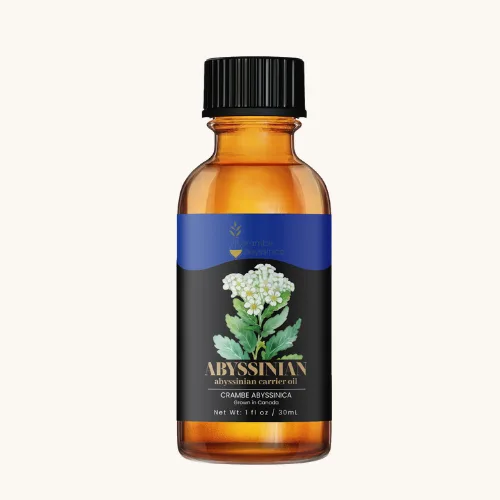
Abyssinian Oil
Cold-pressed Abyssinian oil, in sizes from 0.5 oz to bulk.
From $11.99
Shop Abyssinian Oil →What the published numbers say
We looked for figures we could actually read. Two supplier documents give them for crambe oil. One datasheet lists a recommended usage rate of 1 to 100%, which tells you the oil can be used on its own as a finishing or massage oil and is also fine diluted in a blend. A second supplier monograph recommends using it as a silicone replacement at no more than 20%, balanced with oils rich in polyunsaturated fatty acids, and notes that using it at 100% may have a negative effect on the skin barrier. The same page advises caution for compromised skin and for newborns.
Those two statements point different ways, which is the first lesson: published figures describe how a supplier positions its product, so use them as a bracket and then narrow from your own results.
Thinking in oil phase, not total formula
In an emulsion, the oil does not make up the whole formula. It shares the oil phase with butters, esters and the emulsifier, and the oil phase itself is only part of the total. Plain arithmetic helps here: if the oil phase is 20% of your lotion and you want Abyssinian oil to be a quarter of that phase, it lands at 5% of the finished batch. Changing either number moves the answer quickly, which is why it is worth deciding the role first.
| Format | What the oil is doing | Where to start thinking |
|---|---|---|
| Lotion or cream | Lighter share of the oil phase, a smooth glide | A few percent of the finished batch |
| Leave-in hair serum | Slip and gloss, often the main ingredient | A larger share, up to the 20% ceiling in the monograph above if blended |
| Rinse-off conditioner | A small supporting oil in a base that does the conditioning | Low single digits |
| Anhydrous balm or body oil | A major part of the oil phase | Wide: it can lead the blend |
The right-hand column is our reasoning from the figures above and from how those formats are built, not a published recommendation. Please read it that way.
Why leave-on and rinse-off differ
A rinse-off product is mostly washed away, so a given percentage delivers less oil to the skin or hair than the same percentage in a leave-in. That reasoning is the main reason leave-in products tend to carry more oil by weight and rinse-off products less. It also means a leave-in is the place to be careful about feel: too much oil can leave a film that shoppers will notice before anything else.
How to narrow your range
- Make three small batches at a low, middle and high level.
- Compare feel after one minute and after ten.
- Check stability and appearance over a few weeks.
- Pick the lowest level that gives the feel you want. Oil costs add up faster than you expect once volumes grow.
Our formulation guide covers what else to test, and the silicone-free hair post and anhydrous formulas post go into those two formats.
Settle the percentage, then scale
A larger size makes sense once your percentage is settled, because the batch maths is then simple: batch weight times percentage gives the oil you need. Until then, a small size is the sensible way to trial. We bottle every size from the same lots, so a 0.5 oz sample is a fair preview of what you would receive in volume. When the numbers are ready, our bulk buying guide walks through the sizes, and the cost per unit post shows how to compare them.
Whatever you land on, write it down with the lot number, so your next batch matches your last.
Abyssinian Oil
Cold-pressed Abyssinian oil, from a small bottle to bulk sizes.
From $11.99
Shop Abyssinian Oil →Sources & Further Reading
- ABYSSINIAN SEED OIL Also known as Crambe Seed Oil (Natural Sourcing product literature)
- Abyssinian (Crambe) Seed Oil (Botanical Formulations oil monograph)