Going Silicone-Free in Hair Care: Where Plant Oil Fits
Rub a drop of dimethicone between your fingers and you feel what makes it so popular: a slick, even glide that leaves hair feeling smooth. If you are formulating a silicone-free conditioner or serum, the question is how much of that feeling a plant oil can give you and what changes along the way.
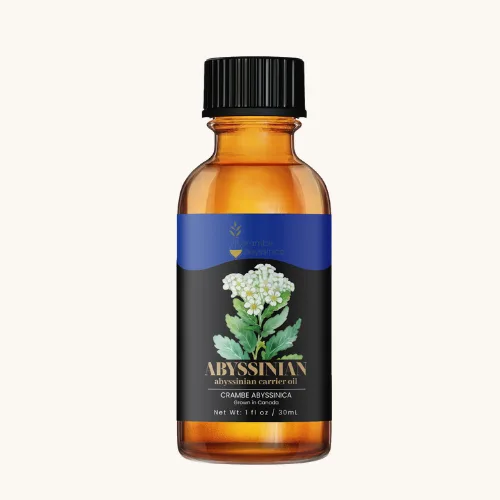
Abyssinian Oil
Cold-pressed Abyssinian oil, in sizes from 0.5 oz to bulk.
From $11.99
Shop Abyssinian Oil →What silicones are doing in the bottle
A review of hair cosmetics describes silicone as the most active and widely used conditioning agent, with dimethicone the most common of the family. Hair care brands reach for it for slip while combing, shine, and a smooth feel. The review notes that some silicones add shine by reflecting light, and that dimethicones are hydrophobic, so they cling to hair rather than rinsing away easily. Different silicones also differ in how well they deposit and wash out, which is why they are used so differently across products.
That list is useful because it turns the question into something testable: slip, shine, light film, feel. A plant oil can be judged on each.
What an oil can offer instead
Crambe oil is a long-chain, mostly monounsaturated oil with low viscosity. One supplier monograph calls it a silky oil that can be used in hair and skin products as a silicone replacement, and says a few drops give an instantly glossy appearance before it is absorbed. Another datasheet lists good slip and spreadability. Those are supplier descriptions, and your own base will decide the result.
Here is our editorial read on what that means in practice. An oil like this can give slip and gloss. It will not be identical to a silicone: it feels different, and it may behave differently over repeated use. So test at a low level first and work upward, watching for weight and sheen.
Pairing it with conditioning agents
An oil on its own is not a conditioner. Hair's surface carries a negative charge, and the same review explains that cationic conditioning agents are attracted to it and help smooth the fibre surface and minimize frizz. In a rinse-off conditioner the cationic agents do the conditioning and the oil adds feel and gloss to what they set up. That is why the oil usually plays a supporting role there.
The same review also warns that cationic polymers can be hard to remove, and that residue is a point of interest with leave-on products. Seen that way, build-up is something to evaluate in any system, silicone or not. Compare a few washes in, not just the first.
Three formats to try
- Leave-in serum. The oil can lead. Compare gloss and feel against your current serum.
- Rinse-off conditioner. Add a small amount to a cationic base and watch for changes in slip and rinse feel.
- Styling cream. Use it in the oil phase of an emulsion for a lighter feel than a heavier butter.
For levels to start from, see our usage rates post, and for the wider picture of how this oil fits a formula, our formulation guide.
Our honest advice for a brand
Treat Abyssinian oil as one tool, not a one-to-one replacement. Put it head to head with your current serum: same base, same level of application, and a few people comparing combing, shine and feel. If it wins on your priorities, you have a story that is true. If it does not, you have saved yourself a reformulation. The cosmetic effects we are talking about are feel, shine and appearance only. For brands that want the consumer side, our silicone alternative post covers the shopper-facing side of the same question, and our meadowfoam comparison looks at another oil often considered for the job.
We sell Abyssinian oil from 0.5 oz up, and our hair care brands page is a good starting point if you are building a line. Tell us what you make and we will help where we can.
Silicone-free is a design brief, and plant oils are one of several ways to meet it.
Abyssinian Oil
Cold-pressed Abyssinian oil, from a small bottle to bulk sizes.
From $11.99
Shop Abyssinian Oil →Sources & Further Reading
- Hair Cosmetics: An Overview (M. F. R. G. Dias, International Journal of Trichology, 2015)
- Abyssinian (Crambe) Seed Oil (Botanical Formulations oil monograph)
- ABYSSINIAN SEED OIL Also known as Crambe Seed Oil (Natural Sourcing product literature)