How to Read a Plant Oil Certificate of Analysis
A certificate of analysis is the most useful page a plant oil comes with, and the one most people skim. It is a lot like a car's service record: individually dull, but together they tell you whether this particular lot will behave the way you expect. Here is how to read one, using Abyssinian oil as our example.
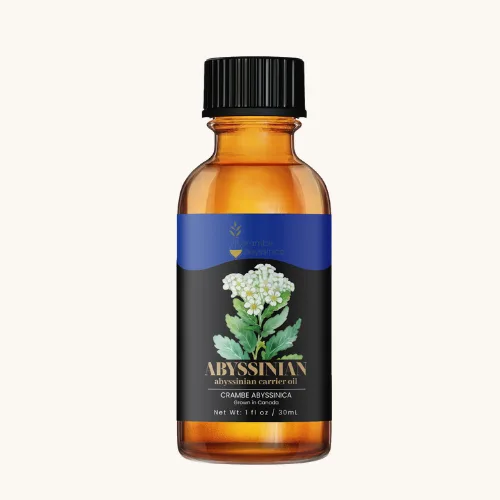
Abyssinian Oil
Cold-pressed Abyssinian oil, in sizes from 0.5 oz to bulk.
From $11.99
Shop Abyssinian Oil →Three documents, three jobs
People use these terms interchangeably, but they answer different questions.
- A spec sheet says what the supplier aims for: typical ranges for a product line.
- A certificate of analysis (COA) reports what was measured on one specific lot, with a lot number and a test date.
- A safety data sheet (SDS) covers handling, storage and hazard information.
If a document has no lot number, it is a spec sheet, however it is titled. If it has no test date, you cannot tell how old the numbers are.
The lines you will see
Appearance, colour and odour. Plain observations, and a quick sanity check against what arrives. Published datasheets describe crambe oil as clear to pale yellow with a faint, characteristic aroma. Ours is light and golden with a mild, nutty aroma.
Acid value. This measures free fatty acids, which build up as an oil ages or when seeds were damaged before pressing. Lower is fresher. As a general yardstick for plant oils, the Codex food standard for named vegetable oils allows up to 0.6 mg KOH/g for refined oils and 4.0 mg KOH/g for cold pressed and virgin oils, which tells you that pressing method changes what a normal number looks like. Codex is a food standard and it does not name crambe, so treat it as a frame of reference and not a pass mark for a cosmetic ingredient.
Peroxide value. This is an early signal of oxidation. The same standard allows up to 10 milliequivalents of active oxygen per kg for refined oils and up to 15 for cold pressed and virgin ones. The useful habit is comparison: a low number on a fresh lot is reassuring, and a number that creeps up across lots deserves a question.
Fatty acid composition. Run by gas chromatography, this is the fingerprint. For crambe oil, a published datasheet lists erucic acid at 50 to 65%, oleic acid at 10 to 25% and linoleic acid at 7 to 15%, and a second monograph says erucic acid can be present up to 60%. Those are general figures for the oil as a category. What matters on a COA is that the lot sits in a sensible range and that the profile matches the oil you were told you were buying. We go deeper in the fatty acid profile post.
Iodine and saponification values. The iodine value reflects how unsaturated the oil is, and the saponification value tells a soap maker how much alkali the oil needs. Most cosmetic formulators will use them for cross-checking more than for daily decisions.
Moisture. A very small number, but water in an oil matters over a long shelf life.
Reading between the lines
Three questions make a COA far more informative.
- Which method? Good certificates name a method (AOCS or ISO methods are common). Two labs using different methods can report slightly different numbers for the same oil.
- Which lot, and when? The lot number should match what is on your drum or bottle.
- Whose lab? In-house results and independent lab results are different kinds of evidence, and either can be fine if you know which you have.
Datasheets for the same oil can also disagree. One supplier lists a 2 year shelf life for its refined crambe oil, another lists 3 years or more, and the processing route is different. A number on a page belongs to that product and that lot, not to the whole category. That is the reason to ask for the lot-specific document.
What to ask for
Decide what your own labels, files and customers require first, then ask for exactly that. Tell us which documents you need before you order and write to [email protected] with the sizes you are considering; our wholesale page has the rest. Our sourcing questions post lists the other things worth asking any supplier, and how to tell a genuine Abyssinian oil covers what you can check yourself. If you are putting the oil into a formula, our formulation guide picks up from there.
A COA will never replace your own trial, but it makes your first trial a lot more meaningful.
Abyssinian Oil
Cold-pressed Abyssinian oil, from a small bottle to bulk sizes.
From $11.99
Shop Abyssinian Oil →Sources & Further Reading
- Standard for Named Vegetable Oils, CXS 210-1999 (Codex Alimentarius)
- ABYSSINIAN SEED OIL Also known as Crambe Seed Oil (Natural Sourcing product literature)
- Abyssinian (Crambe) Seed Oil (Botanical Formulations oil monograph)