Abyssinian Oil vs Marula Oil: Two African Lightweights
Marula and Abyssinian oil are often tucked into the same sentence as "light African oils", and the pairing is a fair one. They come from different plants on different parts of the continent, and when you look at what is inside each bottle, they turn out to be quite different oils that happen to land in a similar spot on the shelf.
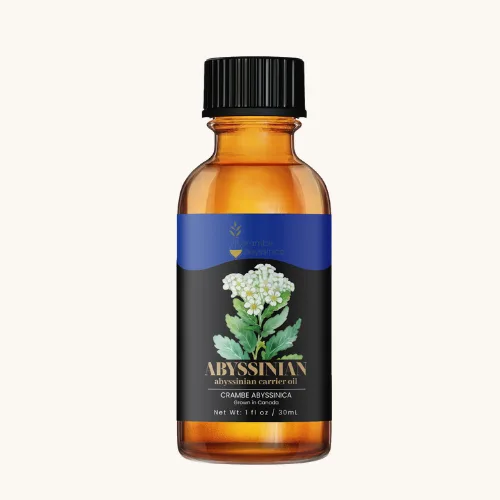
Abyssinian Oil
Cold-pressed Abyssinian oil, in sizes from 0.5 oz to bulk.
From $11.99
Shop Abyssinian Oil →Two plants, two stories
Marula is a tree in the cashew and mango family, with a subspecies native to southern Africa, and its oil is pressed from the kernel inside the hard stone of the fruit. Abyssinian oil comes from the seeds of Crambe abyssinica, a plant native to Eastern Africa that is grown as an oilseed crop. One is gathered from trees, the other is a seed crop, so they start life very differently even though both end up as a light, golden-toned oil.
What is inside
This is where the two part ways. A published analysis of marula kernel oil, from kernels collected from more than twenty trees in Zimbabwe, found oleic acid made up about 73% of the fatty acids, with linoleic acid near 8% and saturated fats near 7%. That is a classic oleic-rich oil, the same family as olive.
Crambe oil follows another recipe. In published analyses, more than 55% of its fatty acids are erucic acid, a chain of 22 carbons with a single double bond, noticeably longer than oleic acid's 18. Our oil is cold-pressed, golden, mildly nutty and lightweight and non-greasy.
Both are built mostly on fatty acids with a single double bond, which is the kind that tends to keep well. That is a reasoned point about their chemistry, not a shelf-life figure for any particular bottle. The marula study is one sample, so take the exact percentages as a typical picture rather than a promise.
How they feel
Chain length is a reasonable guide to feel. Our reading is that oleic-rich oils feel softer and rounder, while longer chains lean toward silky and quick. So we would expect marula to feel a touch richer and Abyssinian oil a touch lighter, again a reading of the fat profile rather than a test result. If you have both on hand, you will form your own view in a few minutes. Both are light enough to use on the face and on hair.
Face or hair
- On the face, a light oil is a good fit when you want an oil step that does not leave a heavy film. Abyssinian oil is a natural choice here; our post on using crambe oil on the face goes through how to apply a small amount.
- On hair, either one can add shine to the ends of dry hair. Marula's extra body can suit thicker hair, and Abyssinian oil suits people who prefer the lightest finish.
If we had to sum up the choice in one line, it is this: marula for people who like a rounder, oleic-style feel, Abyssinian oil for people who want the lightest touch. Neither is a wrong answer, and the difference is small enough that personal preference will decide it. Trying a small bottle of each is the cheapest way to settle the question.
Using them together
Since the two are close in weight, blending is easy: add the second oil in small steps to the first and stop when the feel is right. We sell Abyssinian oil only, so marula is one for a craft supply shop or a pharmacy shelf. If you are choosing between several oils at once, our carrier oil chart compares nine of them, and the posts on argan and rosehip cover two more.
A good rule when you try any new oil on skin is to patch test first and keep it away from the eyes. Beyond that, enjoy the comparison: two African seed and kernel oils, each with a character of its own, is not a bad problem to have.
Abyssinian Oil
Cold-pressed Abyssinian oil, from a small bottle to bulk sizes.
From $11.99
Shop Abyssinian Oil →Sources & Further Reading
- Chemical Profile and Potential Applications of Sclerocarya birrea (A.Rich.) Hochst. subsp. caffra (Sond.) Kokwaro Kernel Oils: Analysis of Volatile Compounds and Fatty Acids
- Marula [Sclerocarya birrea (A. Rich.) Hochst.] products as a food and medicine
- Crambe hispanica Subsp. abyssinica Diacylglycerol Acyltransferase Specificities Towards Diacylglycerols and Acyl-CoA