Abyssinian Oil vs Other Carrier Oils: A Plain Chart
Put nine carrier oils side by side and most of the differences you can feel come down to one thing: the shape of the fat molecules inside. Short, saturated chains make a solid, rich oil. Chains with several double bonds make a thin, fast oil that goes off quickly. Very long chains with a single bond do something in between, and that is where our Abyssinian oil sits.
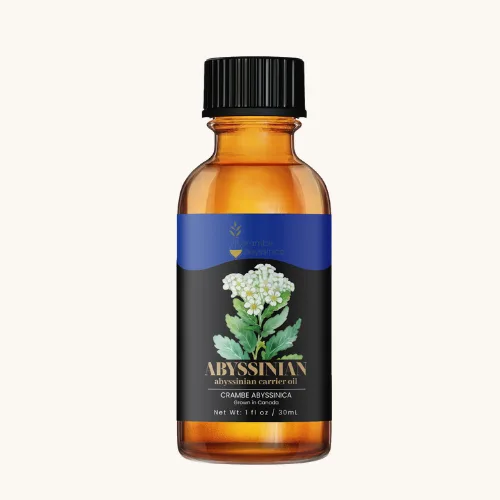
Abyssinian Oil
Cold-pressed Abyssinian oil, in sizes from 0.5 oz to bulk.
From $11.99
Shop Abyssinian Oil →The one idea behind the chart
Every plant oil is built from fatty acids, and three properties of those fatty acids do most of the work. Chain length affects how the oil feels as it spreads. The number of double bonds affects how quickly it meets oxygen and starts to turn. And saturation decides whether the oil is liquid or solid at room temperature.
Once you hold that idea, the table below stops being a list of numbers. You can read a row and predict the feel and the shelf behaviour. The percentages come from published analyses of each oil in general, not from any one bottle, and real samples vary by variety, harvest and pressing. The last two columns are our reading of what those numbers suggest.
| Oil | Main fats (published) | What that suggests for feel | Keeping quality |
|---|---|---|---|
| Abyssinian (crambe) | Over 55% erucic acid, one double bond, very long chain | Light, silky, non-greasy | Slow to turn |
| Jojoba | Over 98% wax esters, not a triglyceride oil | Light, low viscosity | Slow to turn |
| Meadowfoam | About 95% fatty acids of 20 carbons or more | Clear, low viscosity | Slow to turn |
| Squalane | Fully saturated hydrocarbon | Smooth, light emollient | Very slow to turn |
| Marula | About 73% oleic acid, about 8% linoleic | Medium-light | Moderate |
| Argan | Oleic 43 to 49, linoleic 29 to 37, plus tocopherols | Medium | Moderate |
| Grapeseed | Linoleic 65 to 75%, oleic 20 to 40% | Thin, light | Quicker to turn |
| Rosehip | Linoleic or alpha-linolenic dominant, depending on sample | Light, varies by sample | Quicker to turn |
| Coconut | Lauric acid about 46 to 48%, mostly saturated | Rich, solid in a cool room | Slow to turn |
Where Abyssinian oil earns its place
Crambe oil is unusual because its main fatty acid, erucic acid, is a very long chain with only one double bond. Long chains give the oil a silky glide, and a single double bond gives it few places for oxygen to attack. So in practice you get a light, golden oil that is lightweight and non-greasy, and that should keep better than the thin, polyunsaturated oils. That is the combination we built our shop around, and it is why people reach for Abyssinian oil when they want a finishing oil for hair or a light layer for face and body. Our oil is cold-pressed with a mild nutty aroma. If you want to see how that plays out on hair, our posts on fine hair and silicone-style slip go into it.
Where the others win
We sell only Abyssinian oil, so take this section as honest shopping advice rather than a pitch. Several of these oils are the better answer for particular jobs.
- Jojoba is a liquid wax, and that makes it a different kind of ingredient altogether. Our jojoba comparison explains why.
- Squalane is the pick when you want a pure, very stable emollient. It is made by hydrogenating squalene, which is what we cover in our squalane comparison.
- Coconut is the richest on the shelf and suits people who want weight and cushion, as we discuss in our coconut comparison.
- Argan and marula are the familiar nutty, oleic-and-linoleic oils, with a little more body than Abyssinian. See argan and marula.
- Meadowfoam is Abyssinian oil's closest cousin by chain length, and that post walks through the small differences.
- Grapeseed and rosehip are thin, polyunsaturated oils. They are lovely and light, and they ask for a little more care in how you store them; see grapeseed and rosehip.
You will find most of these at a craft supply shop, a pharmacy or a well-stocked grocery store.
A recommendation for each need
For a light finishing oil on hair, Abyssinian or meadowfoam. For a single very stable ingredient to anchor a formula, squalane. For a rich body oil you want to feel, coconut or argan. For a fast, thin oil you plan to use up quickly, grapeseed or rosehip. If you are weighing Abyssinian oil for a particular skin concern, a dermatologist is the right person to ask; we sell a cosmetic oil, and our comedogenicity post explains how to read the rating claims you will see online. If you want the full picture of the plant and the oil first, start with what crambe oil is.
The nice thing about a chart like this is that it keeps working after you close the page. Next time a new oil turns up with a long list of claims, look at its fatty acids first and you will already know most of what matters.
Abyssinian Oil
Cold-pressed Abyssinian oil, from a small bottle to bulk sizes.
From $11.99
Shop Abyssinian Oil →Sources & Further Reading
- Crambe hispanica Subsp. abyssinica Diacylglycerol Acyltransferase Specificities Towards Diacylglycerols and Acyl-CoA
- A Comprehensive Review of Plant-Based Cosmetic Oils (Virgin Coconut Oil, Olive Oil, Argan Oil, and Jojoba Oil): Chemical and Biological Properties and Their Cosmeceutical Applications
- Chemical Profile and Potential Applications of Sclerocarya birrea (A.Rich.) Hochst. subsp. caffra (Sond.) Kokwaro Kernel Oils: Analysis of Volatile Compounds and Fatty Acids
- Meadowfoam seed oil as a natural dispersing agent for colorants in lipstick
- Comparative Analysis of Grape Seed Oil, Linseed Oil, and a Blend: In Vivo Effects of Supplementation
- Characterization of Bulgarian Rosehip Oil by GC-MS, UV-VIS Spectroscopy, Colorimetry, FTIR Spectroscopy, and 3D Excitation-Emission Fluorescence Spectra
- From Olive Pomace to Squalane: A Green Chemistry Route Using 2‑Methyltetrahydrofuran