Abyssinian Oil vs Meadowfoam Oil: Two Long-Chain Oils
Most plant oils are built from fatty acids with sixteen or eighteen carbons. Abyssinian oil and meadowfoam oil are the two cosmetic oils that go much longer, and that single fact is why people reach for them in the same breath. They are not twins, though, and a brand choosing between them is really choosing between two different long-chain stories.
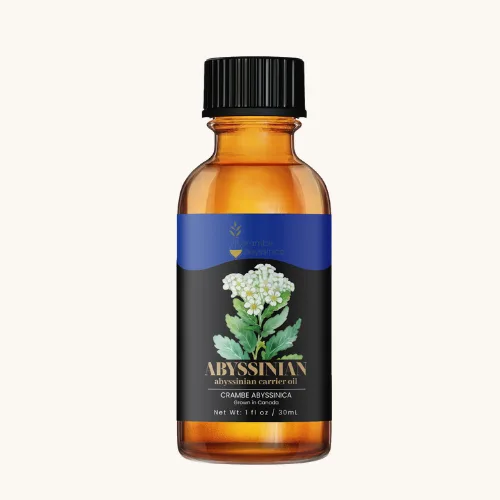
Abyssinian Oil
Cold-pressed Abyssinian oil, in sizes from 0.5 oz to bulk.
From $11.99
Shop Abyssinian Oil →What "long chain" actually buys you
Crambe seed oil is dominated by erucic acid, a 22-carbon fatty acid with one double bond, at roughly 55 to 60 percent of the oil in the published literature (Purdue's crop profile). The rest is mostly the familiar 18-carbon trio: oleic, linoleic and linolenic. We lay all of this out in our fatty acid profile post.
Meadowfoam seed oil goes further. A 2021 cosmetic-science paper describes it as a triglyceride made of approximately 95 percent fatty acids with chain lengths of 20 carbons or more, mainly C20 and C22, with its double bonds at unusual positions, the delta-5 and delta-13 spots. Those authors credit that structure with high oxidative stability, higher than castor oil's. So meadowfoam is long chain nearly all the way through, while crambe is long chain at its centre and ordinary around the edges.
Our reasoning from this: fewer double bonds, and more distance between them, means less for oxygen to work on, and long chains tend to give an oil a cushioned glide. That is the shared quality that makes both oils interesting. It is also why we point curious readers to our oxidative stability guide before they compare any two oils on shelf life alone.
Where they part ways
Feel is the first difference. Our Abyssinian oil is a light, golden, cold-pressed oil with a mild nutty aroma that we describe as lightweight and non-greasy. We do not sell meadowfoam, so we will leave its feel to its own suppliers, and suggest a sample of each before committing to a formula.
Make-up is the second. Meadowfoam has little of the 18-carbon linoleic and linolenic acids that crambe oil carries, because nearly all of its fatty acids are 20 carbons or longer. Crambe oil keeps a share of oleic and linoleic alongside the erucic. Which of those you prefer depends on what you are building.
The third difference is documented job history. Meadowfoam has a published track record as a pigment dispersant: in the same 2021 paper, a meadowfoam dispersion held up in lipstick, performing about like castor oil and octyldodecanol, with the lowest friction of the lipsticks tested at 40 percent pigment. If you are formulating color cosmetics, that evidence is a point in its favor. For Abyssinian oil, the stronger story today is in leave-in hair and facial oils, where a light glide and a golden color are assets. Our silicone-free hair formulation post shows what that looks like on paper.
How a formulator might choose
If you want a light finishing oil with a faint nutty note and the long-chain glide, Abyssinian oil fits, and every size from 0.5 oz to 400 lb is bottled from the same lots, so a small sample tells you what bulk will be. If you are formulating something where a very neutral, well-documented dispersing oil is the goal, meadowfoam is worth testing alongside it.
Both belong in the family of oils we compare in our carrier oil roundup. Cost is a question for your own supplier quotes, since it moves with harvest and demand; tell us what you are making if you would like us to talk through sizes.
The nice thing about two long-chain oils is that you rarely have to settle it on paper. A bench sample of each, side by side, will tell you more than any comparison, ours included.
Abyssinian Oil
Cold-pressed Abyssinian oil, from a small bottle to bulk sizes.
From $11.99
Shop Abyssinian Oil →Sources & Further Reading
- Meadowfoam seed oil as a natural dispersing agent for colorants in lipstick (International Journal of Cosmetic Science, 2021)
- Crambe abyssinica Hochst. ex R.E.Fries (Purdue NewCROP)
- Functional analysis of the omega-6 fatty acid desaturase (CaFAD2) gene family of the oil seed crop Crambe abyssinica (BMC Plant Biology, 2013)