Why Abyssinian Oil Holds Up: Oxidative Stability Explained
Every bottle of oil is quietly reacting with the air inside it, from the day it is pressed. For a brand with a shelf life to defend, the useful question is how fast. Crambe oil, which we sell as Abyssinian oil, has a fatty acid make-up that gives it a head start, and it is worth understanding why before you plan a stability study.
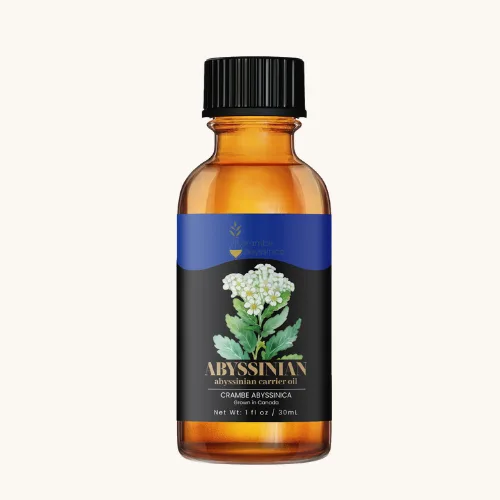
Abyssinian Oil
Cold-pressed Abyssinian oil, in sizes from 0.5 oz to bulk.
From $11.99
Shop Abyssinian Oil →The chemistry in one picture
Oils go off when oxygen attacks the double bonds in their fatty acid chains. The general rule in lipid chemistry is simple: the more double bonds a chain carries, the more places oxygen can strike, and the faster it goes rancid. An oil built mostly from chains with a single double bond tends to outlast one built from chains with two or three.
Published analyses of crambe oil describe exactly that kind of profile. In one hexane-extracted sample, a single-double-bond fatty acid, erucic acid, made up about 64 percent of the total, and a separate 2018 analysis of raw crambe oil reported erucic acid at 63.77 percent, oleic at 15.07 percent and linoleic at 13.16 percent (our post on the fatty acid profile goes through the full picture). Most of the chains are the slow-reacting kind, and the more reactive ones are a minority. That is reasoning from published general data about crambe oil, not a measurement of any one bottle, so treat it as the reason to expect good behaviour rather than a promise.
What a Rancimat test is telling you
The standard accelerated test is the Rancimat, sometimes called the oxidation stability index. A stream of air is bubbled through a heated sample, and the instrument watches for the moment volatile by-products of oxidation appear. The time that takes is the induction time: the longer, the sturdier the oil (the instrument maker explains the method in Application Bulletin AB-204).
The number only means something alongside its conditions. One published characterisation of crambe oil reported an induction period of about 8.8 hours at 110 degrees C. Another paper, using a different instrument and temperature, reported 2.55 hours at 120 degrees C for raw crambe oil and 32.8 hours at 80 degrees C. Those figures do not contradict each other; they were measured differently. So when anyone quotes you an induction time, ask for the temperature and the method, and only compare numbers measured the same way.
Where vitamin E fits
Tocopherols, the family that includes vitamin E, are antioxidants that sacrifice themselves first, which is why they show up in these tests. The same 2012 characterisation found the three common tocopherols in crambe oil at modest levels, roughly 130 milligrams per kilogram combined. An added tocopherol is therefore a reasonable lever for a finished product. We would not guess a percentage here: ask your antioxidant supplier for their recommended range, add it in your next trial batch, and let the stability data decide whether it earns its place.
A stability study you can actually run
You do not need a lab to start; you need discipline and a notebook. This is common practice rather than a prescribed method, so adapt it to your product.
- Keep a sealed control of the plain oil from the same lot, stored cool and dark, to compare against.
- Store finished samples in the actual packaging at room temperature and at a warmer spot, so you see change sooner.
- Check on a schedule: odour first (a sharp, paint-like or crayon note is the early warning), then colour, then peroxide value if you can send samples to a lab.
- Record the lot and the date you opened it for every sample.
The aim is a date you can defend on the box, not the biggest number you can reach.
Small habits that matter more than gadgets
Large manufacturers blanket their tanks with nitrogen; for most indie brands that is not the practical lever. What helps is much more ordinary. Date every lot on arrival. Decant into smaller containers so the main supply is opened rarely and keeps little air above it. Keep caps tight, keep oil out of warm windows, and fill packaging as full as the product allows. Our shelf life and storage post covers the storage side, and the post on balms, sticks and oil serums shows where these habits meet a real formula.
If you want data on the oil you will really use, order a small bottle first. Our Abyssinian oil is cold-pressed and every size is bottled from the same lots, so a 0.5 oz sample in your own study tells you about the larger quantity you may buy later (see the oil itself). Tell us which documents you need before you order, and plan the rest of your launch with the formulation guide.
Stability is mostly patience and good records. Start the clock early, write everything down, and the shelf life you print will be one you can stand behind.
Abyssinian Oil
Cold-pressed Abyssinian oil, from a small bottle to bulk sizes.
From $11.99
Shop Abyssinian Oil →Sources & Further Reading
- Full Characterisation of Crambe abyssinica Hochst. Seed Oil, Journal of the American Oil Chemists' Society, 2012.
- Spectroscopic Methods in the Evaluation of Modified Vegetable Base Oils from Crambe abyssinica, Molecules, 2018.
- Oxidation stability of oils and fats – Rancimat method, Metrohm Application Bulletin AB-204.