Winter Oil Blends: Vanilla, Sandalwood and Cedarwood
Open a jar of vanilla "essential oil" and you may be holding something that was never distilled at all. Vanilla beans do not give up their aroma to steam, so the vanilla in winter blends comes in other forms, and knowing which one you have decides whether your blend mixes smoothly or sits in a cloudy layer. The same goes for sandalwood and cedarwood: each name covers more than one tree.
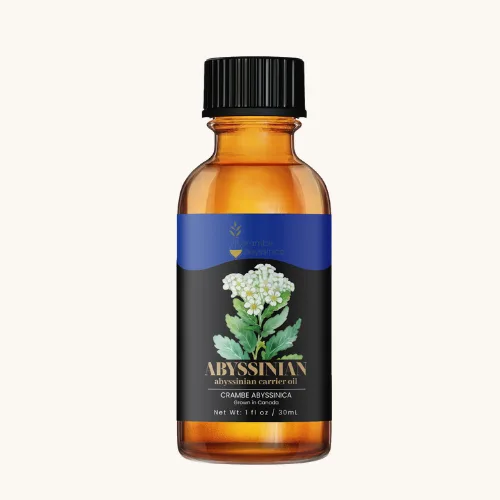
Abyssinian Oil
Cold-pressed Abyssinian oil, in sizes from 0.5 oz to bulk.
From $11.99
Shop Abyssinian Oil →What "vanilla" means in a bottle
One supplier's guide to the forms of vanilla states plainly that steam distillation does not release the bean's aromatic compounds. What you can buy instead are four things. An absolute is a solvent extract, used mainly in perfumery. A CO2 extract is made with supercritical carbon dioxide and is dark amber and thick. An oleoresin is a single-step solvent extract, and the same source notes it does not dissolve well in lipids. The fourth is a bean infusion: vanilla beans soaked in a carrier oil for roughly one to four weeks.
For a winter body oil, we would reach for the infusion or the CO2 extract. The infusion is already oil, so it blends without fuss. The oleoresin's poor solubility in oils makes it the awkward choice for an oil blend. If a seller calls something "vanilla essential oil", ask which of these it is.
Sandalwood: ask which tree
Santalum album, Indian sandalwood, is the classic. The Tisserand Institute notes it was classified as vulnerable by the IUCN in 1998 for its wild populations, and that oil from cultivated Australian plantations has taken over much of the supply. The same article lists what Indian sandalwood oil is sometimes mixed with, including Australian and African sandalwood oil, amyris and inert diluents such as castor or coconut oil. Australian sandalwood, Santalum spicatum, is a different species that is now extensively cultivated.
The practical lesson is a short list of questions for the seller: the Latin name, the country of origin and whether the oil is plantation grown. A seller who answers readily is a good sign, especially given how many substitutes the adulterant list above contains.
Cedarwood is two different trees
Atlas cedarwood comes from Cedrus atlantica, a true cedar, and has a dry, warm aroma. Virginia cedarwood comes from Juniperus virginiana, which Virginia Tech Extension points out is a juniper and not a true cedar at all. Its aroma is dry and pencil-like. Both are woody base notes, so you can choose by nose: Atlas for something warmer, Virginia for the sharpened-pencil dryness.
Two winter blends, worked out
These come from the Tisserand Institute's general ranges (1 to 3% for body oils, 0.5 to 1.2% for facial products) and plain arithmetic at about 20 drops to the milliliter. The percentage counts every essential oil in the bottle together. Tisserand's table leaves out oils with specific restrictions, so check each oil's supplier safety sheet, and note that we have kept both blends inside the lower half of their ranges.
A body oil for cold weather
In 60 ml of Abyssinian oil, 1.5% is 0.9 ml, about 18 drops: nine sandalwood, six cedarwood and three vanilla CO2 extract. If you have a vanilla infusion instead, skip the vanilla drops and replace about a fifth of the base with it (12 ml infusion and 48 ml Abyssinian oil), which stays plain arithmetic and needs no percentage.
Apply it straight after the shower to damp skin, the way the American Academy of Dermatology suggests for any moisturizer. Our post on dry winter skin covers the seasonal swap, and after-shower body oil covers how much to use.
A beard oil with some depth
For the skin under a beard and the look of the beard itself, treat the blend as a facial product. In 30 ml, 0.8% is 0.24 ml, about 5 drops: two cedarwood, two sandalwood and one vanilla extract. Our lightweight beard oil recipe has the base method, and a woody scent is a pleasant fit for it. Our oil gives softness and shine; the rest is scent.
Patch test first, as we say for our own oil, keep blends away from the eyes, and store them out of reach of young children. Tisserand recommends anyone who is pregnant ask a doctor or a suitable practitioner before using essential oils. For the wider map of scent families, see essential oil pairings.
Warm, dry and a little sweet is a good description of winter anyway, and three oils are enough to say it.
Abyssinian Oil
Cold-pressed Abyssinian oil, from a small bottle to bulk sizes.
From $11.99
Shop Abyssinian Oil →Sources & Further Reading
- The Different Forms of Vanilla Essential Oil and Their Benefits
- Santalum Album Oil Rejuvenated
- Eastern Redcedar, Juniperus virginiana
- Cedarwood (Atlas) vs Cedarwood (Virginia): Differences, Aroma, Uses & Safety
- Dilution for essential oils
- How to Use Essential Oils Safely
- Dermatologists' top tips for relieving dry skin